IMAT 2027/2028 Candidate Handbook
Official Exam Regulations & Complete Guide
The definitive handbook for the International Medical Admissions Test (IMAT): Ministerial Decree rules, EU/Non-EU pathways, visa bureaucracy, test formats, global exam venues, complete topic-by-topic syllabus, and scoring strategies.
Regulated in strict compliance with Decree n. 1005 (MUR, 6 August 2026). Single national test administered simultaneously across Italy and 33 international test centres worldwide.

What is the IMAT?
The International Medical Admissions Test (IMAT) is a standardized national entrance examination for international and domestic students who wish to study Medicine and Surgery (Medicina e Chirurgia, LM-41) or Dentistry (Odontoiatria, LM-46) taught entirely in English at Italian public state universities.
Why Study Medicine in Italy?
Italian medical schools are among the oldest and most prestigious in Europe (Bologna, Padua, Pavia, Milan), with traditions dating back centuries.
Tuition fees at public universities are income-based (calculated via ISEE Parificato) and typically range from only €156 to €4,000 per year, far lower than US, UK, or Caribbean medical schools.
Graduates earn the EU-recognized Laurea Magistrale a Ciclo Unico (LM-41), granting automatic medical license recognition across all 27 EU member states, EEA, and Switzerland under Directive 2005/36/EC.
All lectures, laboratory coursework, exams, and textbook materials are delivered in English. Italian language courses are provided by universities for clinical patient communication.
Practical clinical rotations (Tirocini Pratico-Valutativi) start early in major academic teaching hospitals, with bedside patient interaction and qualifying medical board assessments.
Italian medical degrees are recognized worldwide, including the UK General Medical Council (GMC), USA ECFMG/USMLE Steps 1 & 2, Canada, and Australia.
6-Year Integrated Curriculum Structure (360 ECTS)
Focus on basic medical sciences and underlying biological mechanisms: Medical Physics, General & Inorganic Chemistry, Organic Chemistry, Biochemistry, Human Anatomy & Histology, Molecular Biology & Genetics, Human Physiology, Microbiology, and General Pathology.
Bedside rotations in university hospitals: Internal Medicine, General & Specialized Surgery, Pharmacology, Pathology, Obstetrics & Gynecology, Pediatrics, Psychiatry, Neurology, Diagnostic Imaging, and Emergency Medicine. Concludes with the qualifying practical exam and experimental thesis defense (Tesi di Laurea).
Who is this Comprehensive Guide For?
- EU & EEA high school graduates
- Non-EU students applying from abroad
- Non-EU residents in Italy (Parificati)
- University transfer & degree holders
- Dual-citizenship passport holders
- Parents & academic counselors
EU vs Non-EU Citizenship Status & Strategy
The most critical legal distinction in the entire Italian medical admissions system.
🇪🇺 EU Candidates & Parificati
National MeritApplies to: Citizens of Italy, all 27 EU member states, Norway, Iceland, Liechtenstein, Switzerland, San Marino, Vatican City, and Non-EU citizens holding qualifying Italian residence permits (Parificati).
- Unlimited University Choices: Can list all participating Italian medical schools in strict order of preference (1st choice, 2nd choice, etc.).
- Single National Ranking List: Compete in the nationwide merit ranking (Graduatoria Unica Nazionale) with weekly rolling shifts (Scorrimenti).
- Re-allocation Flexibility: If you miss your 1st choice, your score automatically slides down to your 2nd or 3rd preference as spots open up.
- Minimum Eligibility Threshold: Must score at least 20.0 points to enter the official national ranking.
- Zero Visa Red Tape: No pre-enrolment on Universitaly required; no study visa needed. Full freedom of movement.
- Exam Venue Freedom: Can sit the exam at any test centre in Italy or abroad.
🌏 Non-EU Candidates Residing Abroad
Single ChoiceApplies to: Citizens of all non-EU/EEA countries who reside outside of Italy and require a Type D national study visa to enter Italy.
- Strict 1-University Rule: Can apply to ONLY ONE single medical university per academic year. Choice is locked at pre-enrolment.
- Isolated Local Ranking: Compete ONLY against other Non-EU candidates who chose that exact same university. No scrolling to other schools!
- High Risk / High Reward: Scoring 70+ points at a high-competition school (e.g. Milan/Pavia) yields 0 seats if cut-off is 72, whereas 50 points would win at Bari or Messina.
- Minimum Threshold: Need greater than 0.0 points (any positive score) to be eligible, but practical cut-offs are much higher.
- Mandatory Bureaucracy: Must submit pre-enrolment on Universitaly, obtain Declaration of Value (DoV) or CIMEA, and secure a Type D Study Visa.
- Exam Venue Rules: Can sit exam in your home country abroad, or if sitting in Italy, MUST sit at the university chosen.
Non-EU Citizens Residing in Italy (Parificati - Non-UE Equiparati)
Under Art. 39, paragraph 5 of Legislative Decree n. 286/1998 (Testo Unico sull'Immigrazione), non-EU citizens who legally hold certain Italian residence permits are classified as "Non-UE Parificati" (Non-EU equivalent to EU). They do NOT apply through the Non-EU foreign quota; instead, they compete directly under the EU national ranking with unlimited choices and rolling admissions!
Eligible Italian Residence Permits (Permessi di Soggiorno Validi):
- EU Long-Term Resident Permit: Permesso di soggiorno UE per soggiornanti di lungo periodo (ex Carta di Soggiorno).
- Family Reasons: Permesso di soggiorno per motivi familiari.
- Work Permit: Permesso per lavoro subordinato o per lavoro autonomo.
- Asylum & Protection: Asilo politico, protezione sussidiaria, o motivi umanitari/protezione speciale.
- Religious Reasons: Permesso di soggiorno per motivi religiosi.
- Elective Residency: Permesso per residenza elettiva.
Because Non-EU candidates abroad can only choose one university, hundreds of exceptional students are rejected simply because their single choice had an abnormally high cut-off. To bypass this restriction, strategic international students use the 1-Year Parificato Route:
Dual Citizenship (Which Passport to Use?)
Under Italian administrative law, if you hold both an EU citizenship and a Non-EU citizenship (e.g. Italy + USA, Brazil + Italy, Portugal + Argentina), the EU citizenship legally supersedes.
Special Case: UK Citizens & Brexit
Since Brexit, UK passport holders are classified as Non-EU candidates and are subject to the single-university quota rule.
- • Withdrawal Agreement Exception: UK citizens holding an Italian residency permit issued before 31 December 2020 are treated as EU candidates.
- • Irish Passport Advantage: UK candidates holding dual Irish citizenship can apply under Ireland as full EU citizens.
Statistical Comparison: EU vs Non-EU Competition Dynamics
Bureaucracy & Visa Roadmap (Non-EU Only)
The comprehensive document pipeline: Universitaly pre-enrolment, DoV vs CIMEA, Type D Visa, and Italian Permit of Stay.
1 Step 1: Universitaly Pre-enrolment (Domanda di Preiscrizione)
All non-EU students residing abroad must complete an official pre-enrolment application on the ministerial portal Universitaly.it. This step verifies your high school diploma and officially links your profile with the Italian Embassy/Consulate in your country.
Step-by-Step Universitaly Submission Protocol:
- 1. Account Creation: Register on Universitaly.it with your legal name exactly as shown in your passport.
- 2. Select "International Students": Access the Pre-enrolment Application (Domanda di Preiscrizione) section for the upcoming academic year.
- 3. Specify Program & University: Choose Corso di Laurea Magistrale a Ciclo Unico -> Medicina e Chirurgia (in lingua inglese). Select your ONE target university.
- 4. Select Competent Consulate: Choose the exact Italian Embassy or Consulate General responsible for your jurisdiction where you will submit your visa dossier.
- 5. Document Uploads: Upload high-resolution colour scans of your Passport, High School Diploma, Academic Transcripts, and English proficiency certificate (if required).
- 6. Language Requirement Check: While IMAT is the admission test, many universities (Milan, Sapienza, Pavia) require uploading an English proficiency certificate (IELTS 6.0/C1, TOEFL, Cambridge) during pre-enrolment unless you completed schooling in English. Always verify your target university's Bando di Concorso.
- 7. University Validation: Once submitted, the university's international desk reviews your files. Upon validation, Universitaly issues the official Summary PDF (Riepilogo) transmitted directly to your Italian embassy.
2 Step 2: Declaration of Value (DoV) vs. CIMEA Statement of Comparability
Italian universities legally require certified proof that your secondary school diploma represents at least 12 years of formal education and confers university entrance eligibility in your home country. Candidates must obtain either a consular Declaration of Value or a CIMEA digital certificate:
Special Case: 11-Year Schooling Systems (e.g. Russia, Central Asia, Middle East)
If your secondary school system spans only 11 years, Italian law stipulates that you must compensate for the missing 12th year via one of the following official remedies:
- 1 Year of University Studies: Complete at least 1 academic year (60 ECTS or equivalent credits) with all exams passed at a recognized home-country university.
- Advanced Placement (AP) Exams: Present at least 3 US College Board AP exams with scores of 3 or higher in relevant scientific disciplines.
- Foundation Year Program: Complete an accredited 1-year Foundation Course taught at an Italian university before matriculation.
3 Step 3: Italian Study Visa Application (Type D - National Visa)
Once Universitaly validates your pre-enrolment, you must book an appointment at your Italian consulate via Prenot@Mi or external visa processing centers (VFS Global, TLScontact). Prepare the following mandatory dossier:
4 Step 4: Arrival in Italy & Permesso di Soggiorno (The Strict 8-Day Rule)
Within 8 working days of crossing the Italian border, non-EU study visa holders must legally request their Italian Residence Permit (Permesso di Soggiorno per Motivi di Studio):
- Collect the "Kit Giallo": Visit an authorized post office (Poste Italiane) with a Sportello Amico counter and request the free residence permit kit.
- Complete Modulo 1: Fill out personal data, visa details, and Italian residential address. Attach passport copies and health insurance.
- Submit & Pay Fees: Submit the envelope at the post office, pay the electronic card fee (~€70.46) and revenue stamp (Marca da bollo €16.00).
- Keep the Postal Receipt (Ricevuta): The post office issues a holographic receipt containing a user ID and password. This receipt is legally equivalent to a permit and allows you to matriculate and travel.
- Attend Questura Fingerprinting: Attend your scheduled biometric appointment at the local immigration police headquarters (Questura).
Non-EU Student Bureaucracy Roadmap (Month-by-Month)
IMAT Registration & Application Procedures
Official registration on Universitaly, university preferences, test centre selection rules, fees, and exam day checklist.
Registration Timing & Platform
Official registration for the IMAT examination takes place exclusively on the ministerial portal Universitaly.it. Registration typically opens in July (or September in 2026 under DM 1005) and remains accessible for approximately 2 to 3 weeks.
🇪🇺 EU & Parificati Registration Flow
- 1. Log in to your verified account on Universitaly.it.
- 2. Select "Iscrizione alla prova di ammissione - IMAT".
- 3. Rank all desired medical faculties: Enter your 1st choice and subsequent preferences in strict order. You can modify preferences until the deadline.
- 4. Select Exam Centre: Choose any available test centre in Italy or abroad.
- 5. Pay Fee: Pay via PagoPA or international credit/debit card (~€130 / £114 / $164).
- 6. Download and save the Registration Payment Receipt (Ricevuta di Iscrizione).
🌏 Non-EU Abroad Registration Flow
- 1. Log in with the same Universitaly account used for pre-enrolment.
- 2. Select "Iscrizione alla prova di ammissione - IMAT".
- 3. University Choice Locked: The portal automatically binds your test registration to your single pre-enrolment university.
- 4. Select Test Centre: Choose an official international test centre in your home country/region, or select Italy.
- 5. If taking the test in Italy, you MUST take it at your chosen university campus.
- 6. Pay exam fee and ensure your valid passport number matches both applications.
The IMAT registration fee is confirmed annually by ministerial decree (approx. €130.00 / £114.00 / $164.00). Paid via credit/debit card on Universitaly or authorized banking circuit.
Candidates choosing Italy who are EU citizens typically take the test at their 1st choice university. Non-EU candidates sitting in Italy take it at their single pre-enrolment university.
For system errors during registration, submit a ticket via the official Universitaly Help Desk. Always capture full-screen screenshots showing error codes, date, and time.
Official IMAT 2026 Schedule & Key Deadlines
Confirmed by Ministerial Decree n. 1005 (MUR, 6 August 2026). Late actions are strictly rejected.
Application on Universitaly
Complete registration exclusively through the Universitaly portal. This deadline is irrevocable — late registrations are not accepted under any circumstances.
Admission Test
Italian centres begin at 13:30 (GMT+2); international centres follow their confirmed local time zone. Set by Ministerial Decree n. 1005.
Anonymous Scores Released
Scores without candidate identification are released for national transparency. Find your score using the alphanumeric barcode code from your test package.
Access to Exam Paper & Data Sheet
Candidate inspects their scored optical answer sheet, question booklet, total score, and candidate data sheet inside their reserved area.
National Ranking List Published
The official national ranking for EU and local rankings for Non-EU candidates determine eligibility. Enrolment opens immediately.
Subsequent Ranking Updates (Scorrimenti)
Weekly national updates reassign vacant seats as candidates accept or forfeit. Candidates must click "Confirm Interest" to remain in the ranking.
Test Format, Syllabus Distribution & Tie-Breakers
The IMAT is a paper-based exam of 60 multiple-choice questions (5 options each) in 100 minutes, prepared by CINECA for MUR.
60 Questions Distribution by Subject

Official Legal Tie-Breakers (In Strict Order)
-
1
Section Score Superiority: In case of equal total score, prevailing score in: Biology > Chemistry > Physics & Mathematics > Logical Reasoning > Reading Skills.
-
2
Official Language & Disability Certifications: CEFR English Certificate (B2/C1/C2) or certified disability status.
-
3
Age Priority Criterion: The younger candidate ranks higher than the older candidate.
Required Documents for the Exam (What to Bring)
Strict candidate inspection at check-in. Only 3 items are permitted on your desk.

Photographic Identification (Original & Valid)
A current government-issued photo ID. International candidates should carry their valid original passport (the exact one entered during Universitaly registration). Copies or expired documents are rejected.
Black Pen
Usually provided at the examination centre, but you should bring your own black ballpoint pen as a backup. The optical scanner reads black ink only.
Water Bottle (Optional)
Must be completely transparent, with all labels, branding, wrappers, or markings completely removed before entering the test hall.
Prohibited Items & Grounds for Test Annulment (Disqualification)
Strictly forbidden inside the test room. Possession alone — even switched off — is grounds for immediate exclusion!
Mobile phones, smartwatches, tablets, PDAs, headsets, earphones, webcams, or any connected device.
Any calculating device, including watch or phone calculators. All math and physics must be solved by hand.
Textbooks, formula sheets, handwritten notes, printed study material — including partial reproductions.
Blank sheets, notebooks, pencils, erasers, or correction fluid (Tipp-Ex). Two draft sheets are issued by the centre.
All bags, cases, and outer belongings must be deposited at the cloakroom as instructed by the centre.
No branded or labelled bottles, snacks, or containers at your desk. Only transparent unlabelled bottles.
- Entering the wrong exam room, unless explicitly authorised by the commission.
- Possession or use of unauthorised devices or materials inside the hall.
- Adding signatures, names, or any identification marks to the optical answer sheet.
- Copying, communicating, or exchanging materials with other candidates.
- Altering forms after they have been placed in the official submission boxes.

Exam Day Procedure & Optical Answer Sheet Marking Guide
Detailed step-by-step protocol for starting the test, checking barcodes, and marking answers.
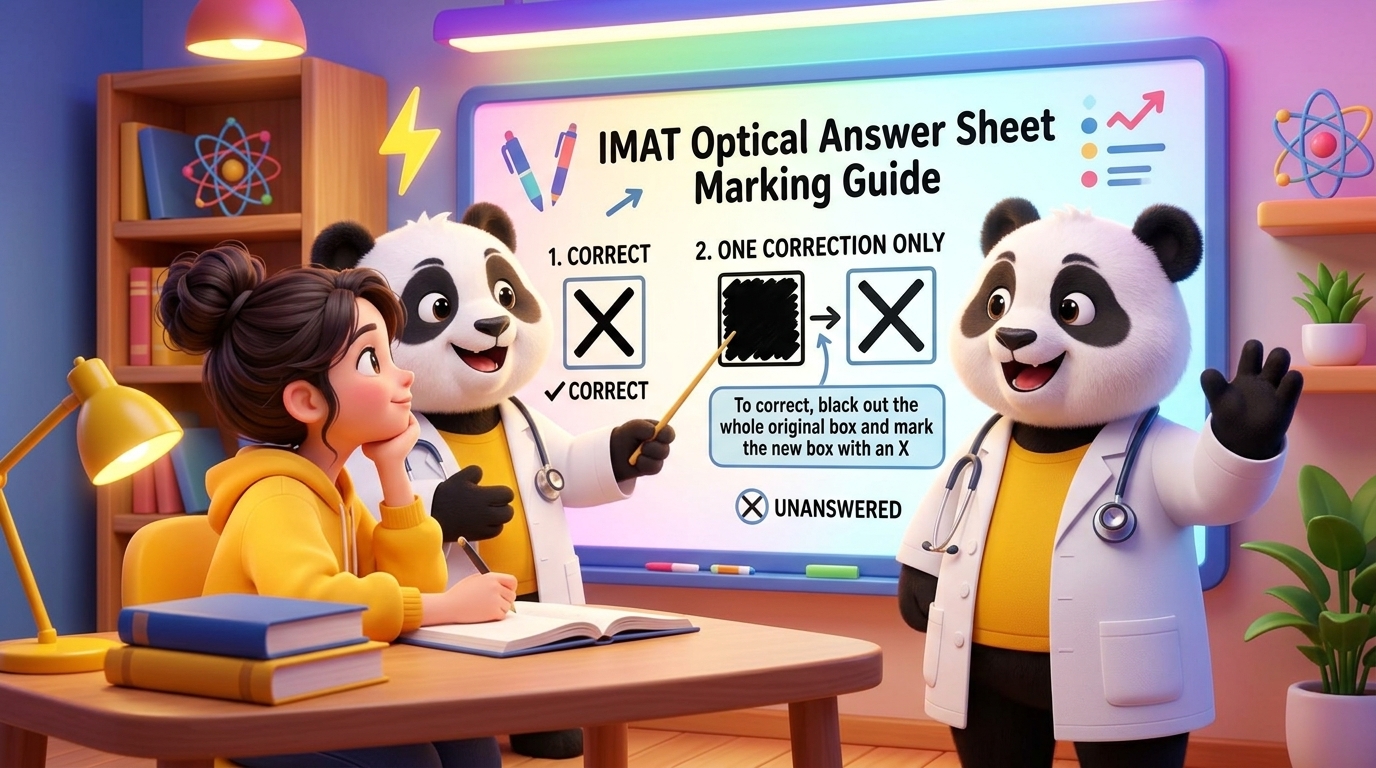
Official Optical Marking Format:
Starting the Test Protocol
-
1
Integrity Verification: The supervisor randomly selects four candidates to inspect and verify the physical integrity of the sealed exam boxes.
-
2
Candidate Package Handout: Each candidate receives:
- Candidate Data Sheet (without ID code)
- Test Questions booklet (with code) + 2 draft sheets — do not open until instructed!
- Cover Sheet with barcode, and Answer Sheet (same code as the test booklet)
-
3
Check Barcode Parity: Check that the barcodes on your cover sheet, answer sheet, and question booklet are IDENTICAL. If they do not match, raise your hand immediately! (Note: the data sheet has no barcode).
-
4
Fill Data Sheet (DO NOT SIGN YET): Fill out personal details on the data sheet, but do not sign it yet. If signed by accident, immediately notify the invigilator and request a replacement.
-
5
Opening the Test: Open the question booklet only when instructed by the commission supervisor.
-
6
100 Minutes & Warnings: Total duration is exactly 100 minutes. Verbal warnings will be announced when 30 minutes and 10 minutes remain.
-
7
Room Confinement: Once the test begins, you may not leave the room except for certified medical emergencies, and only with invigilator approval.
When time is called, stop writing immediately. Remain seated until instructed to hand in your materials. Submit every single item: the answer sheet, cover sheet, question booklet, and both draft sheets. Ensure your answer sheet is clean. Once submitted, sheets cannot be removed or swapped under any circumstances.
Complete Official IMAT Syllabus Breakdown & Preparation Guide
Topic-by-topic scientific curriculum based on the Italian Ministerial Decree, recommended resources, and study timelines.
1-2 Sections 1 & 2: Reading Skills & Knowledge (4 Qs) + Logical Reasoning (5 Qs)
9 Questions Total (13.5 Points)Under recent MUR guidelines, these sections prioritize reading comprehension, critical analysis of non-fiction passages, deductive logic, and broad cultural awareness over esoteric trivia:
3 Section 3: Biology (23 Questions - 34.5 Points) - The King of the IMAT!
38.3% of Exam MarksBiology is the single highest-yielding subject in the IMAT. It acts as the primary legal tie-breaker and represents the core foundation of your medical admissions score:
4 Section 4: Chemistry (15 Questions - 22.5 Points)
25.0% of Exam MarksChemistry acts as the second official tie-breaker and requires mastery of chemical principles, reaction stoichiometry, and organic mechanisms:
5 Section 5: Physics & Mathematics (13 Questions - 19.5 Points)
21.7% of Exam MarksRecommended Preparation Resources
• MUR IMAT Papers (2023–2025): Highest relevance for current question styles and difficulty.
• Cambridge IMAT Papers (2011–2022): Excellent for deep biology and chemistry practice.
• BMAT Section 2 (2003–2023): Outstanding high-speed science questions.
• Biology: Campbell Biology (11th or 12th Edition) or IB Biology Higher Level.
• Chemistry: Pearson Chemistry or Cambridge International AS/A-Level Chemistry.
• Physics & Math: Giancoli Physics / IB Physics Standard Level.
• Meditaliano: 6,000+ categorized questions, full TOLC-MED translations, 20+ realistic simulations, and personalized 1-on-1 tutoring.
• PassIMAT / Medschool.it: Question banks and forum discussions.
Structured Study Plans: From Foundations to Test Day
Complete initial theory sweep of Biology and Chemistry. Establish daily flashcard routines (Anki). Take an un-timed diagnostic test.
Master organic reaction mechanisms and human organ systems. Complete 500+ practice questions per subject. Drill non-calculator math.
Solve full past papers under strict 100-minute timed conditions. Maintain an exhaustive Error Log explaining root causes of every mistake.
2 to 3 full simulations per week. Rapid revision of high-yield Biology and Chemistry tables. Optical sheet bubbling drills.
Exam Day Scoring Tactics & Expected Value Mathematics
With scoring calibrated at +1.5 for correct and -0.4 for incorrect, intelligent guessing strategy mathematically elevates your final ranking:
-
Zero Eliminations (5 choices)
Expected Value: -0.02 pts
LEAVE BLANK -
Eliminate 1 Option (4 choices)
Expected Value: +0.075 pts
TOLERABLE RISK -
Eliminate 2 Options (3 choices)
Expected Value: +0.233 pts
ALWAYS GUESS -
Eliminate 3 Options (2 choices)
Expected Value: +0.550 pts
MANDATORY GUESS
Exam Centres & Addresses (33 Global Centres & 17 Italian Universities)
Official Tabella A (MUR Decreto n. 1005). Every country is displayed with its programmed vector flag.
Tirana
Rruga Xhanfize Keko, Tirana 1000
Baku
Mikayil Mushfig 1C, AZ1004 Baku
Baku
Izmir 6, AZ1065 Baku
São Paulo
Av. Braz Leme 3029, Santana, São Paulo SP 02022-011
Toronto
469 Jarvis St, Toronto, ON M4Y 2G8
Beijing
Tuanjiehu Building, No. 17 Tuanjiehu Nanli, Chaoyang District
Nicosia
2 Avraam Antoniou, Lakatamia, Nicosia 2330
Paris
2 Rue de la Butte Verte, 93160 Noisy-le-Grand
Frankfurt
Heerstraße 149, 60488 Frankfurt-Mitte-West
Athens
Leof. Andrea Siggrou 89–93, Athens 11745
Hong Kong
3 Supreme Court Road, Admiralty
New Delhi
Outer Ring Road, Sunder Vihar, Paschim Vihar, New Delhi
New Delhi
Plot No. 4, Sector 13, Dwarka, New Delhi
Chennai
No. 183, NSK Salai, Vadapalani, Chennai
Dublin
25 Wolfe Tone Street, Dublin
Nairobi
Argwings Kodhek Road, Upper Hill, Nairobi
Lahore
257 Khursheed Alam Road, Cantt, Lahore
Karachi
Dalmia Road, near Millennium Mall, Karachi
Islamabad
Opposite DHA2, near Giga Mall, GT Road, Islamabad
Warsaw
Puławska 125, Warsaw
Lisbon
Av. Dom João II, 1990-083 Lisbon
Jeddah
Nahdat Ash Sharq Street, As Salamah District, Jeddah
Johannesburg
40 St Andrews Rd, Hurlingham, Sandton 2196
Madrid
Paseo General Martínez Campos 31, 28010 Madrid
Lugano
Via Giuseppe Cattori 18, 6900 Lugano
Tunis
No. 80, Avenue Mohamed V, 1002 Bab Bhar, Tunis
Istanbul
Yeşilköy, Istanbul 34149
Ankara
Buğduz Mahallesi, 06750 Akyurt/Ankara
Ankara
Çamlıca, Anadolu Blv No:26, Yenimahalle/Ankara
Dubai
Sheikh Zayed Rd, Trade Centre 2, Dubai
London
Richardson House, Boundary Business Court, Church Road, Mitcham CR4 3TD
Birmingham
Church Court, Cox St, Birmingham B3 1RD
New York
520 8th Avenue, 16th Floor, New York, NY 10018
Italian Medical Schools & Official Seat Quotas
Public state universities, private institutions, and Dentistry/Veterinary programs taught in English.
Non-EU Minimum Scores & Cut-Off Analysis
Official historical minimum entry scores, Marco Polo program quotas, and score buffer guidelines.
Under the bilateral Italian-Chinese agreement established in 2006, several Italian medical faculties reserve a specific sub-quota of Non-EU seats for Chinese students (known as "Marco Polo seats"). If these reserved spots are not filled by qualifying Chinese applicants, they are officially reallocated to the general Non-EU abroad pool. For instance, at the University of Pavia, 5 of the 40 Non-EU seats were initially reserved for Marco Polo candidates; when only 1 candidate qualified, the remaining 4 seats reverted to general Non-EU candidates.
Non-EU cutoff scores exhibit significant regional divergence. While northern faculties (Pavia, Milan, Bologna) demand scores above 70.0+, southern universities (Messina, Catania, Marche, Bari) offer substantially higher acceptance rates with cutoffs hovering in the 50.0–62.0 range. Because Non-EU candidates are restricted to a single application, selecting a university that matches your realistic mock exam score distribution is the single most decisive factor in securing your medical seat!
After the Exam: Ranking Lists, Assignment & Enrolment
Understanding your status (Assigned, Booked, Waiting) and the strict deadlines that cost candidates their seat.
Assigned
You have won a definitive place at that university (usually your 1st choice). You MUST complete enrolment within the short window (strictly 4 days) or the seat is forfeited forever.
Booked
You are offered a seat at a lower preference. You may enrol there now, OR confirm interest to remain in the ranking waiting for a higher preference.
Waiting
No place yet. You must click "Confirm Interest" (Conferma di interesse) at each weekly update to stay in the running as other candidates withdraw.
- Missing an Enrolment or Confirmation Deadline: Automatically removes you from the national ranking permanently. Illness, travel, or connection problems are not accepted as grounds for appeal.
- Non-EU Candidates Residing Abroad: Compete only for the single university chosen at pre-enrolment. There is no scrolling to other universities for Non-EU abroad.
- Mandatory Weekly Login: You must log in to Universitaly within the timeframe of each weekly scorrimento to confirm interest.

Personal Strategy Tips & 24-Hour Exam Day Timeline
High-yield advice from top scorers and exam committee procedures.
Top-Scorer Strategy Rules
The 24-Hour Countdown Checklist
Secure Your Medical Seat with Meditaliano
From your initial Universitaly registration to the final national ranking update, our team of record-holder faculty (including IMAT Record 87.0 tutor Nima Rasti) guides you through every step.